
Making Tax Digital – What You Need to Know (and Why It’s Not as Scary as It Sounds)
Making Tax Digital explained in plain English. Find out who it affects, when it starts, and how to get ready without the stress.
BUSINESS
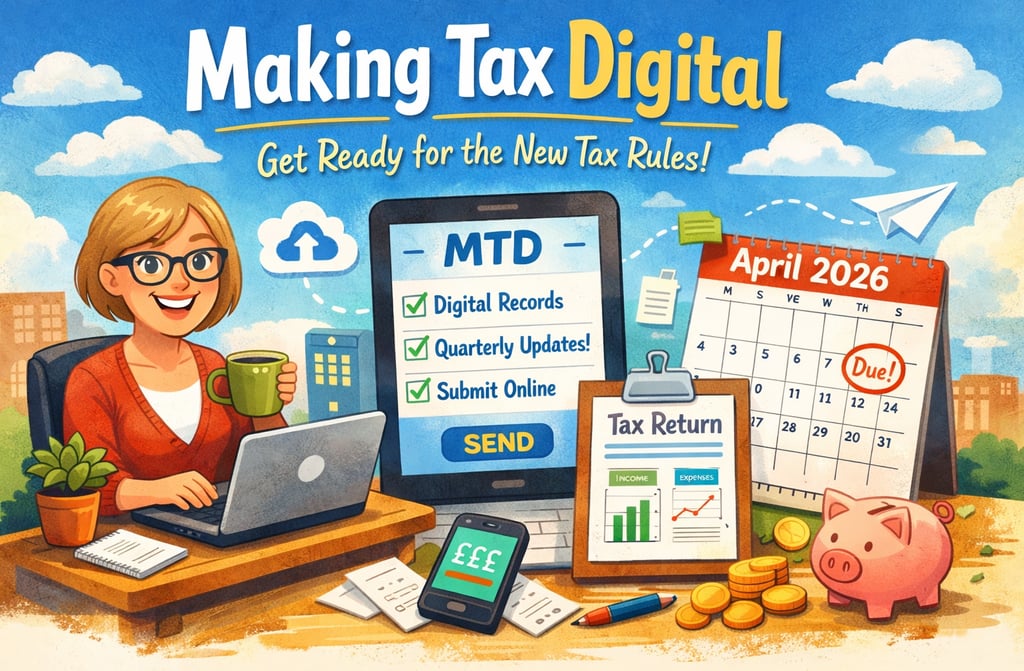
Starting in April 2026, HMRC is bringing about a big change: around 1 million people will need to keep their tax records digitally and send quick updates online every few months. But don’t worry—this isn’t as complicated as it sounds!
This mainly affects:
Sole traders
Landlords
People who are employed but also earn self-employed income (for example, locums)
If you run a limited company or a partnership, you can breathe easy for now—these rules don’t apply to you just yet.
If your head’s spinning a little, don’t panic! I’m here to guide you through, step by step, and make this whole thing a breeze.
So… what actually is Making Tax Digital?
So, what’s this all about? Making Tax Digital (or MTD, as the cool kids at HMRC call it) is just the government’s way of bringing tax into the digital age.
Instead of keeping paper records or spreadsheets and filing one tax return a year, you’ll need to:
Keep your records digitally.
Send HMRC quarterly summaries of your income and expenses.
Do it all through MTD-approved software.
For a lot of us, this is a big shift—especially if you’ve always done things the old-school way. But here’s the good news: it’s really about making life simpler in the long run, not just ticking boxes for HMRC.
What are “digital records”?
This means keeping your business or property income and expenses electronically, not on paper.
That includes:
Money coming in
Money going out
Dates and amounts
As long as you’re using the right kind of software, you’re good to go—no need to stress about the technical details.
What’s happening – and when?
If you’re in the group that’s affected, you’ve probably already had a letter or email about it. Here’s the lowdown in plain English:
April 2025
You can join voluntarily and start getting used to digital records early.April 2026
MTD becomes mandatory if your combined self-employed and property income was £50,000 or more in your 2024/25 tax return.April 2027
The threshold drops to £30,000 (based on your 2025/26 return).April 2028
The threshold drops again to £20,000 (based on your 2026/27 return).
If you started your business partway through a year, HMRC will work out your income so it’s fair. No nasty surprises!
Earning £25,000 in six months may still bring you into MTD.
If you start trading after 6 April 2026, you register only after submitting your first tax return.
How might this affect you?
If MTD applies to you, you’ll need to:
Keep digital records of income and expenses.
Send four quarterly updates each year.
Submit your end-of-year tax return digitally.
That means five submissions a year instead of one.
If your combined self-employed and property income was over £50,000 in 2024/25, this will apply to you from April 2026.
What should you be doing now?
The earlier you start getting ready, the smoother this will go (and the less it’ll mess with your coffee breaks!).
Here’s where I suggest starting:
1. Check your income
Look at your combined self-employed and property income (UK and overseas) for 2024/25.
2. Think about software
You’ll need HMRC-approved software that can:
Keep digital records
Send quarterly updates
File your tax return.
I can help you find software that fits your style—no jargon, no fuss, just something that works for you.
3. Get support (and reassurance!)
You definitely don’t need to turn into a bookkeeper or a tech whiz overnight.
How can I help
I know tax changes can feel overwhelming, especially when an official-looking letter lands on your doormat (or pops up in your inbox).
That’s why I’m here: to make sure you’re never left guessing, and to keep things as simple as possible.
I can help by:
Checking whether MTD applies to you
Recommending and setting up the right software
Explaining bookkeeping in plain English
Handling record-keeping and quarterly updates if you’d rather not
Making sure you stay fully compliant with HMRC
If you’re unsure where you stand, or just want to talk it through, get in touch.
No pressure at all—just a friendly hand to help you get sorted, one step at a time.
Services
Bookkeeping
Payroll management
VAT returns
Self-assessment tax returns
Making Tax Digital ITSA
Management reporting
Contact
bernie@balancedbooksbybernie.co.uk
Balanced Books by Bernie © 2026. All rights reserved.


Opening hours
Monday 9 - 17
Tuesday 9 - 17
Wednesday closed
Thursday 9 - 17
Friday 9 - 17
Saturday closed
Sunday closed
+44 7990 123 153
Licence number 24809