
Making money but still feeling broke in business? Here’s why.
Making a profit but still feeling cash-poor? In this blog, I explain why profit and cash flow are very different — and what small business owners can do to feel more in control of their finances.
BUSINESSBOOKKEEPING

Have you ever looked at your business and thought:
“I’m working constantly, sales are coming in… so why does my bank balance still look awful?”
Honestly, this is one of the most common things small business owners struggle with.
You’re not doing anything wrong, and you’re definitely not alone.
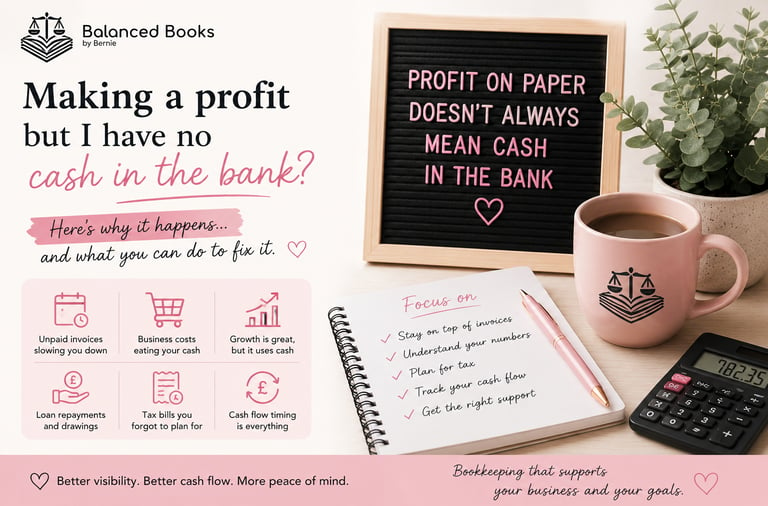
The confusing part is that making a profit and actually having money in the bank are two completely different things.
And yes — you really can be profitable while still feeling skint.
Profit and cash are not the same thing
This catches so many business owners out.
Profit is what’s left after your income and expenses are worked out on paper.
Cash is the actual money sitting in your bank account right now.
So your accounts might show a healthy profit, but if the money hasn’t physically arrived yet — or has already gone back out — your bank balance can still feel very tight.
One of the biggest reasons? Unpaid invoices
This is usually the main culprit.
You’ve done the work, sent the invoice, and your bookkeeping shows the income.
But until the customer actually pays you, the cash isn’t there.
So technically the business is profitable… but your bank account doesn’t feel like it.
This is especially common for service-based businesses.
Business costs can drain cash quickly
Sometimes the money is there — it’s just gone straight back out again.
Things like:
software subscriptions
stock purchases
equipment
insurance
VAT payments
tax bills
loan repayments
can all eat into your cash flow very quickly.
And some of these won’t immediately show the way you expect them to on your reports, which makes everything feel even more confusing.
Taking money out of the business affects cash too
If you’re a sole trader or director, taking money from the business for personal use will obviously reduce what’s left in the bank.
That sounds obvious, but when you’re busy running a business, it’s easy to lose track of how much is actually going out personally.
A lot of business owners only look at sales coming in and forget to look at the full picture.
Growth can actually create cash flow problems
This surprises people, but growing businesses often struggle with cash flow the most.
You might be:
investing in new tools
buying stock upfront
spending more on marketing
outsourcing work
taking on bigger projects
On paper, things are improving.
But in reality, your cash is constantly being tied up somewhere else.
So what can you do about it?
The biggest thing is understanding your numbers properly — not just looking at your bank balance and hoping for the best.
A few things that really help are:
Keeping on top of unpaid invoices - The longer invoices sit unpaid, the tighter cash flow becomes.
Setting money aside for tax - This makes a huge difference and avoids nasty surprises later.
Reviewing your finances regularly - Even 10–15 minutes a week can help you spot problems before they become stressful.
Using bookkeeping software properly - Software is helpful, but only if the information going into it is accurate.
This is exactly why bookkeeping matters
Good bookkeeping isn’t just about staying organised for HMRC.
It helps you understand:
where your money is going
what you can actually afford
whether your business is genuinely healthy
and why your bank balance may not match your profit
Sometimes business owners think they have a “money problem” when actually they have a visibility problem.
Once you can clearly see what’s happening financially, everything starts to feel far less overwhelming.
Need help getting clarity around your finances?
At Balanced Books by Bernie, I help small business owners stay organised, understand their numbers, and feel more in control of their finances — without the stress or confusing jargon.
If your business is making money but your bank account never seems to reflect it, you’re definitely not alone.
Services
Bookkeeping
Payroll management
VAT returns
Self-assessment tax returns
Making Tax Digital ITSA
Management reporting
Contact
bernie@balancedbooksbybernie.co.uk
Balanced Books by Bernie © 2026. All rights reserved.


Opening hours
Monday 9 - 17
Tuesday 9 - 17
Wednesday closed
Thursday 9 - 17
Friday 9 - 17
Saturday closed
Sunday closed
+44 7990 123 153


Licence number 24809