
Do I Still Need an Accountant or Bookkeeper with MTD?
With Making Tax Digital on the way, many sole traders are wondering if accounting software will replace the need for a bookkeeper or accountant. Here’s what you need to know and why support can still be valuable.
BOOKKEEPING
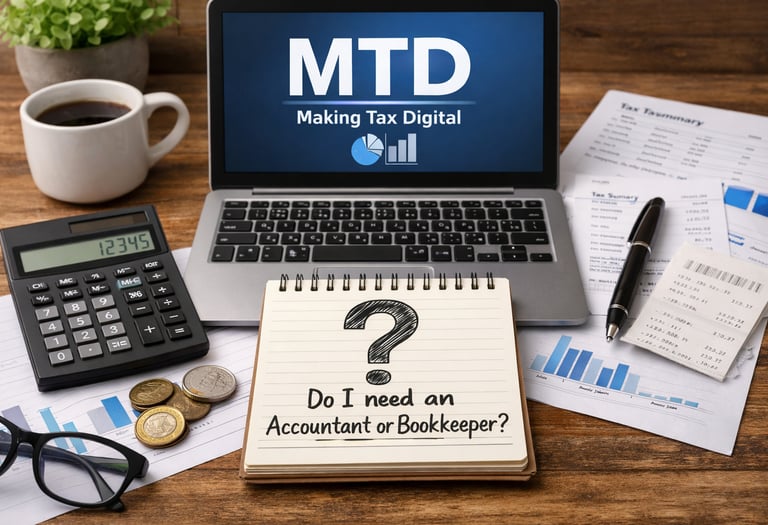
With Making Tax Digital (MTD) for Income Tax on the way, many sole traders are starting to ask the same question:
“If everything is digital, do I still need an accountant or bookkeeper?”
It’s a fair question. After all, if software can send your figures directly to HMRC, it might sound like you can just handle everything yourself.
The truth is, for some people that might work. But for many small business owners, a bookkeeper or accountant can still make a big difference.
Let’s take a look at what’s changing — and where support can still help.
What Is Making Tax Digital?
Making Tax Digital is HMRC’s plan to move the tax system away from the traditional once-a-year tax return and towards more regular digital reporting.
For sole traders, this means:
Keeping digital records of your income and expenses
Sending quarterly updates to HMRC through approved software
Submitting a final tax return at the end of the tax year
The idea is to make tax reporting more accurate and reduce last-minute stress.
When Will MTD Affect Sole Traders?
MTD for Income Tax is being introduced gradually.
From April 2026 – Sole traders earning over £50,000 must follow MTD rules
From April 2027 – The threshold drops to £30,000
From April 2028 – It is expected to drop further to £20,000
If your income is below these levels, you can continue using the current Self Assessment system for now.
Does MTD Replace Your Accountant?
Not necessarily.
MTD changes how information is reported, but it doesn’t replace financial advice, tax planning, or bookkeeping support.
The software can help you submit figures to HMRC, but it won’t always tell you:
Which expenses you can claim
Whether you’re setting aside enough tax
If you’re missing potential tax savings
How to structure your business finances properly
That’s where a professional can still add value.
What Software Can (and Can’t) Do
MTD-compatible software like QuickBooks or Xero can help you:
Record income and expenses
Keep digital records
Submit updates directly to HMRC
But software still relies on accurate information being entered in the first place.
If transactions are categorised incorrectly or something is missed, it can lead to incorrect figures being reported.
A bookkeeper helps make sure your records are accurate and organised, which makes everything much smoother when it’s time to submit your updates.
When Sole Traders Might Want Support
Some sole traders are perfectly happy managing their own bookkeeping. Others prefer to focus on running their business rather than keeping on top of financial admin.
Working with a bookkeeper can help if you:
Don’t enjoy doing the bookkeeping yourself
Want to make sure everything is done correctly
Prefer someone else to keep an eye on deadlines and compliance
Want help understanding your business finances
It can also be especially helpful when transitioning to the new MTD system.
Making MTD Work for You
Making Tax Digital is really about modernising how businesses manage their finances.
For many sole traders, switching to digital systems actually makes things easier once everything is set up properly.
Whether you manage your own records or work with a professional, the key is making sure your system works smoothly and keeps you compliant with HMRC.
Need a Hand with Making Tax Digital?
If you’re unsure whether MTD will affect you, or you’d like help getting your bookkeeping systems ready, I’m always happy to help.
At Balanced Books by Bernie, I work with sole traders to keep their finances organised, compliant, and stress-free.
Get in touch for a friendly chat about how I can support your business.
Services
Bookkeeping
Payroll management
VAT returns
Self-assessment tax returns
Making Tax Digital ITSA
Management reporting
Contact
bernie@balancedbooksbybernie.co.uk
Balanced Books by Bernie © 2026. All rights reserved.

Opening hours
Monday 9 - 17
Tuesday 9 - 17
Wednesday closed
Thursday 9 - 17
Friday 9 - 17
Saturday closed
Sunday closed
+44 7990 123 153
Licence number 24809